

What Is an NCC Transfer in Italy? Everything You Need to Know (2026)
Introduction – What Is an NCC Transfer in Italy?
If you have ever searched for a private transfer in Italy, you have almost certainly seen the letters NCC — on websites, on car windows, on booking platforms, and even printed on driver jackets outside Italian airports.
But what does NCC actually mean? Is it a taxi? Is it an Uber? Is it a luxury service only for business travellers? And most importantly — is it the right option for your trip?
This guide answers every question travellers ask about NCC transfers in Italy, clearly and without jargon. By the end, you will know exactly what an NCC is, how it differs from a taxi, what to expect when you book one, and how to make sure the service you are booking is legitimate.

What Does NCC Stand For?
NCC stands for Noleggio con Conducente — which translates directly from Italian as “rental with driver” or “hire with driver.”
It is Italy’s official legal category for licensed private hire vehicles — the equivalent of what other countries call a chauffeur service, private transfer, or minicab. In practice, when an Italian company calls itself an NCC operator, it means they hold a specific municipal licence to transport passengers in a private vehicle, with a professional driver, on a pre-booked basis.
The service is regulated at a national level by Italian Law No. 21 of 15 January 1992, which established the legal framework for all non-scheduled public transport in Italy — including both taxis and NCC services. This law defines what NCC operators can and cannot do, where they can operate, and what qualifications their drivers must hold.
In 2026, there are approximately 110,000 licensed NCC operators across Italy, compared to around 25,000 taxi licences — making NCC the dominant form of licensed private transport in the country.
How Does an NCC Transfer Work?
The core principle of an NCC service is simple: you book in advance, a licensed driver collects you at an agreed location, and takes you to your destination at a fixed price.
Here is how it works in practice:
You contact the NCC operator — by website, phone, WhatsApp, or booking platform — and provide your pickup location, destination, date, time, and number of passengers. The operator gives you a fixed quote. You confirm the booking. On the day, your driver arrives at the agreed point (your hotel, the airport arrivals hall, the cruise ship gangway, or wherever you specify) and takes you directly to your destination.
There is no meter running. No negotiating at the end. No uncertainty. The price you agreed when you booked is the price you pay.
By Italian law, every NCC journey must begin and end at the operator’s registered depot (called a “rimessa”). In practice, this means the driver leaves their base, collects you, takes you to your destination, and returns to base — which is why NCC services are always pre-booked and never hailed from the street like a taxi.
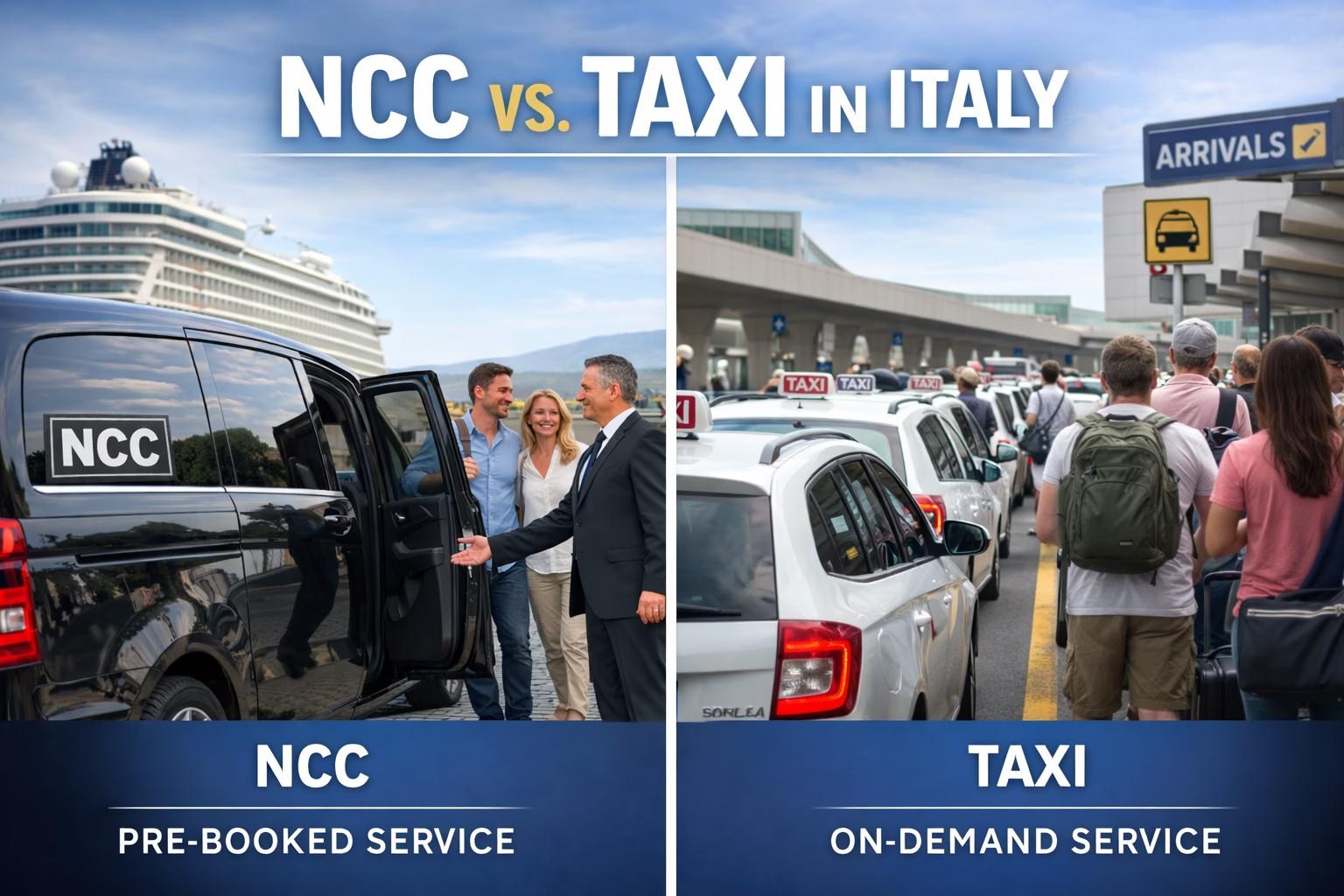
NCC vs Taxi in Italy: What Is the Difference?
This is the question most travellers have, and the answer matters — especially when you are trying to decide how to get from an Italian airport or cruise port to your hotel.
How you book them is the most fundamental difference. A taxi can be hailed on the street, picked up from a taxi rank, or called at the last minute. An NCC must always be pre-booked — the driver cannot legally stop for you on the street or wait at a rank looking for passengers.
How the price is set is the second major difference. Taxis in Italy use a taximeter — the price goes up with every kilometre and every minute stuck in traffic. With an NCC, the price is fixed and agreed before the journey begins. You know exactly what you will pay before you get in the car.
Where they can operate is another key distinction. A taxi licence is tied to a specific municipality — a Rome taxi, for example, is authorised to operate in Rome. An NCC licence allows the operator to collect and drop off passengers anywhere in Italy (and technically, even abroad). This is why NCC services are the standard choice for long-distance transfers between cities, airport-to-coast routes, and cruise port pickups.
The vehicles are also different. Official Italian taxis are white, carry the municipal coat of arms, and have a visible “TAXI” sign on the roof. NCC vehicles are typically dark-coloured (usually black), carry only a small municipal emblem near the licence plate, and have no roof sign. They are generally newer, larger, and more comfortable than standard taxis.
Port and airport access is one of the most important practical differences for travellers — but it’s important to clarify how it works. At major transport hubs such as Civitavecchia Cruise Port and Fiumicino Airport, both taxis and licensed NCC operators hold official permits that allow them to operate in designated professional areas. However, the way they provide service is different. Taxis wait at official taxi ranks and operate on-demand. Passengers join the queue and are served in turn. NCC vehicles, on the other hand, operate strictly by pre-booking. Because the service is reserved in advance, the driver can meet passengers at a specific, agreed meeting point — often inside the arrivals terminal at the airport or at a pre-arranged location within the cruise port area.
So while both services are licensed and authorized to access transport hubs, the key difference is not the permit itself — but the booking model and the personalized meet-and-greet service that NCC operators provide.
Here is a quick summary:
| Taxi | NCC | |
|---|---|---|
| How to book | Street, rank, or last minute | Pre-book only |
| Pricing | Taximeter (variable) | Fixed price, agreed in advance |
| Geographic limit | One municipality | All of Italy |
| Vehicles | White, roof sign | Dark, no roof sign |
| Port/airport access | Restricted zones (with permit) | Restricted zones (with permit) |
| Availability | On demand | Guaranteed (pre-booked) |
📖 Want to know more? Check out our blog for travel tips, transfer guides, and everything you need to plan your trip to Italy. Read our guide Taxi vs. Private Transfer →
Book Your Private Transfer Today!
Enjoy a smooth, stylish, and stress-free journey in the Eternal City.
Is Uber an NCC in Italy?
Yes — and this surprises many travellers. Uber in Italy does not operate the way it does in the US, UK, or most of Europe.
In Italy, Uber drivers are legally required to hold an NCC licence. Uber is not a ride-sharing app here — it is a booking platform that connects passengers with licensed NCC operators. This means Uber in Italy is always pre-booked, never available on-demand the way it is elsewhere, and generally costs more than in other countries. UberX (the standard cheap option) does not exist in most Italian cities. Only UberBlack and similar premium tiers operate, and only in the largest cities like Rome and Milan.
For most tourists in Italy, especially outside major city centres, booking directly with a licensed NCC operator is more reliable, more flexible, and often cheaper than using the Uber app.
What Are the Benefits of Booking an NCC Transfer in Italy?
For tourists, the advantages of using a licensed NCC service over a taxi or public transport are significant — particularly when arriving or departing from an airport or cruise port.
Fixed price with no surprises. You know the cost before you travel. There is no meter, no surge pricing, no “I had to take a longer route because of traffic” conversation at the end.
Door-to-door service. Your driver collects you from where you actually are — your hotel lobby, the airport arrivals hall, your cruise ship gangway — and delivers you to your destination. Not to a nearby taxi rank. Not to the public drop-off area. To the exact point you need.
Guaranteed availability. Because you pre-book, your vehicle is confirmed. There is no risk of arriving at a cruise port at 7 AM with 40 kg of luggage and finding no taxis available because three other ships docked at the same time.
Luggage assistance. NCC drivers are professionals — they load and unload your luggage, handle your bags, and help you settle in. This is particularly valuable for families, older travellers, or anyone with heavy cases.
Flight and ship monitoring. Most professional NCC operators track your flight or cruise arrival in real time, so if your plane is delayed, your driver knows — and adjusts accordingly.
Access to restricted areas. At airports like Fiumicino and Ciampino, and at ports like Civitavecchia, licensed NCC operators with special permits can enter areas closed to private vehicles. This means less walking, less shuttling, and a smoother arrival.
Child seats available. Unlike standard Italian taxis, which rarely carry child seats and whose drivers are often reluctant to install them, NCC operators can arrange certified child seats in advance — an important consideration for travelling families.
How to Check If an NCC Operator Is Legitimate
Unfortunately, not every driver offering a “private transfer” in Italy is licensed. Particularly near airports, train stations, and cruise ports, unlicensed drivers approach tourists offering informal rides at seemingly attractive prices.
Here is how to verify legitimacy before booking:
Check for an NCC licence number — a legitimate operator will display their municipal NCC authorisation number on the vehicle.
Look for a VAT number and registered address — any legitimate Italian business must display these on their website. If you cannot find them, be cautious.
Read reviews that specifically mention pricing accuracy — trustworthy operators receive reviews noting that the final price matched the quoted price. This is a strong signal.
Never book with a driver who approaches you in the street — legitimate NCC operators do not solicit passengers in person at arrival areas. They wait at a pre-agreed point with a sign showing your name.
Avoid cash-only operators — a professional NCC service will accept card payments or online payment at booking. Cash-only arrangements with no receipt are a warning sign.
When Should You Use an NCC Transfer in Italy?
NCC services are the right choice in the following situations:
Airport transfers — arriving or departing from Fiumicino, Ciampino, Milan Malpensa, Naples, or any other Italian airport. A pre-booked NCC means a driver with your name waiting in arrivals, regardless of delays.
Cruise port transfers — to or from Civitavecchia (Rome’s cruise port), Naples, Genoa, Livorno, or Bari. Only licensed NCC operators can access the restricted terminal zones at most Italian ports.
City-to-city transfers — Rome to Florence, Rome to Naples, Rome to Sorrento, Milan to Venice. For longer distances where a taxi would be prohibitively expensive (because the meter keeps running), a fixed-price NCC is significantly better value.
Day trips — hiring a private driver for a day to visit Pompeii, the Amalfi Coast, Tuscany, or any destination that requires a car. Having a driver wait while you explore, without the meter running, is both practical and often more affordable than you expect.
Groups and families — an NCC minivan for 6–8 passengers at a fixed price often works out cheaper per person than multiple taxis or train tickets, and infinitely more comfortable.
Business travel — punctuality and professionalism are guaranteed with a pre-booked NCC, which is why the service is standard for corporate travel in Italy.
How Ciao Transfer Operates as a Licensed NCC in Rome
At Ciao Transfer, we are a fully licensed NCC operator based in the Rome area. Every driver holds the required professional qualification and every vehicle is registered under our NCC municipal authorisation.
We operate 24 hours a day, 7 days a week, across all the routes that matter most to travellers in the Rome area:
- Fiumicino Airport (FCO) to and from Rome city centre, hotels, and onward destinations
- Ciampino Airport (CIA) transfers
- Civitavecchia cruise port transfers — with official port access permits to reach your ship directly
- Rome to Florence, Naples, Sorrento, Positano, and all major destinations
- Rome city tours by private car with a professional driver
When you book with Ciao Transfer, you receive a fixed, all-inclusive price before you confirm. No tolls added later. No night surcharges hidden in the small print. No meter running while we sit in traffic.
👉 Book your private NCC transfer with Ciao Transfer
Quick Checklist: How to Book a Safe NCC Transfer in Italy
✅ Always pre-book — do not accept rides from drivers who approach you at the airport or port
✅ Confirm the price is fixed and all-inclusive before booking
✅ Ask for the operator’s NCC licence number if you have any doubt about legitimacy
✅ Check that reviews mention pricing accuracy — “price as quoted” is a strong trust signal
✅ Confirm luggage policy — how many bags are included, and whether child seats can be arranged
✅ Save the driver’s WhatsApp or contact number before you travel
✅ Confirm the meeting point in writing — airport terminal, hall number, or specific pier at a cruise port
External Resources
- Italian Ministry of Infrastructure and Transport – official information on NCC regulations and the RENT national registry
- Aeroporti di Roma (ADR) – official NCC access rules for Fiumicino and Ciampino airports
- Turismo Roma – Rome’s official tourism portal
- Italia.it – the official Italian tourism portal
Final Thoughts
NCC — Noleggio con Conducente — is Italy’s licensed private hire system, and for most tourists it represents the safest, most comfortable, and most reliable way to travel between airports, cruise ports, hotels, and destinations across the country.
It is not a taxi. It is a pre-booked, fixed-price, door-to-door service operated by professional licensed drivers — with access to restricted airport and port areas.
If you are planning a trip to Italy in 2026, understanding what an NCC is — and how to book one safely — will save you time, stress, and money. And if you need a trusted, licensed NCC service in the Rome area, Ciao Transfer is ready.
👉 Book your transfer with Ciao Transfer — licensed NCC operator, fixed prices, no surprises.
Frequently Asked Questions
What does NCC mean in Italy?
What is the difference between an NCC and a taxi in Italy?
Is Uber an NCC in Italy?
How do I know if an NCC operator is legitimate?
Do NCC transfers have access to airports and cruise ports in Italy?
Is an NCC transfer more expensive than a taxi in Italy?
Does Ciao Transfer operate as a licensed NCC?
Related posts